


































Mitochondria are far more than the cell's power plants. These organelles sustain nearly every physiological process, from muscle contraction to brain activity. Mitochondrial dysfunction contributes to a wide spectrum of human pathologies, from rare inherited disorders to neurodegeneration and aging. To function reliably, they maintain multiple copies per cell of their own genome—mitochondrial DNA (mtDNA)—packed into protein-DNA clusters known as nucleoids. Scientists have long known that nucleoids are evenly spaced along mitochondria, a feature essential for proper inheritance and function. Yet despite its importance, the mechanism underlying this precise genome distribution has remained elusive.
A study now published in Science reveals that the answer was hiding in plain sight, first described more than a century ago. In 1915, Margaret Reed Lewis sketched a striking transformation in which tubular mitochondria adopt a beads-on-a-string shape. Long dismissed as a stress-induced artifact, this phenomenon has now brought back into focus by an international collaboration supported by HFSP.
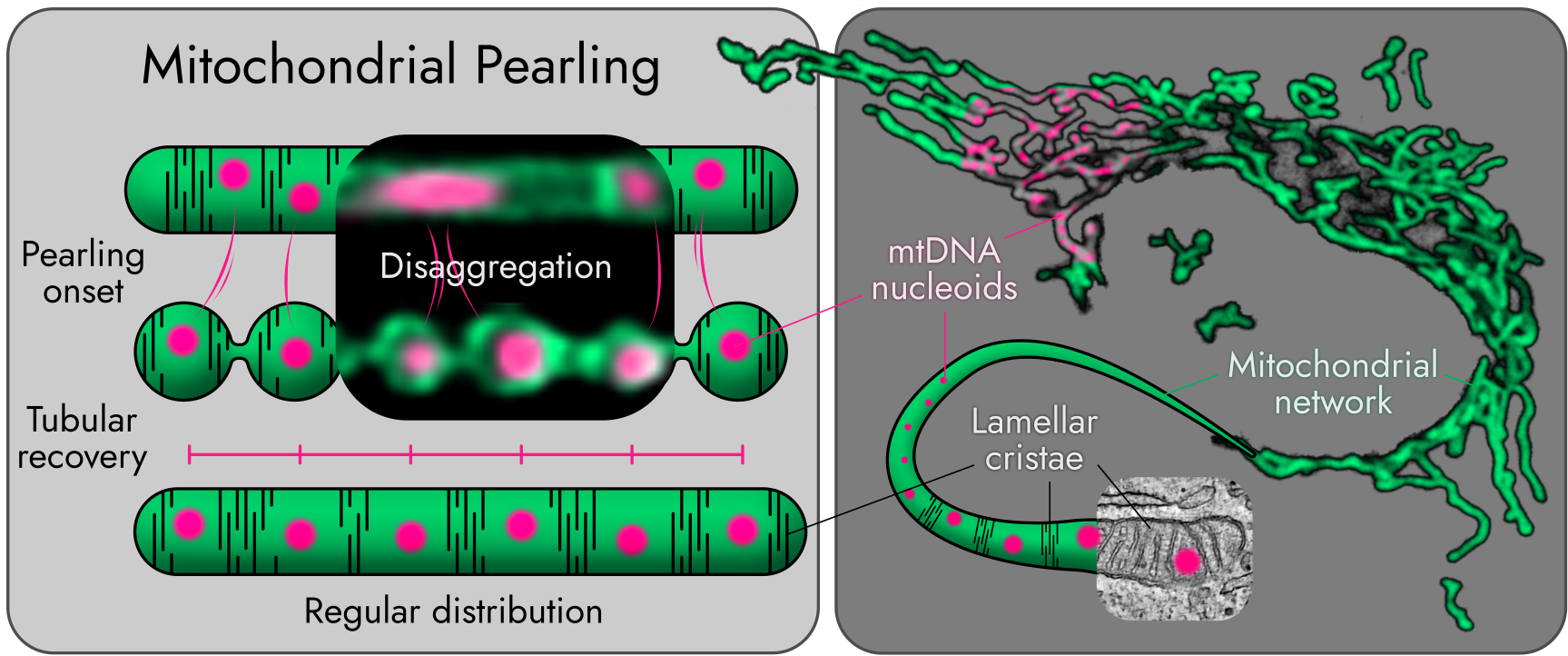
Led by Juan C. Landoni and Suliana Manley at EPFL in Switzerland, the team uncovered reversible mitochondrial pearling as a fundamental dynamic mechanism. Acting both as a genome-spacing ruler and a driver of nucleoid division, pearling provides a unifying explanation for a range of previously disparate observations. Using genetic and pharmacological approaches, the team dissected how pearling is regulated under both physiological and pathological conditions. They found that calcium influx from the endoplasmic reticulum triggers pearling, imposing regular spacing while simultaneously partitioning nucleoid clusters. This ensures the dissemination of newly-made nucleoids with near-maximal precision. The inner mitochondrial membrane folds also play a crucial role, dictating the frequency and persistence of pearling, and maintaining nucleoid separation after mitochondria recover their tubular form.
In parallel, a complementary study led by HFSP collaborators Gabriel Sturm, Wallace Marshall at UCSF provides a physical explanation for the phenomenon. Published in Molecular Biology of the Cell, their work investigated how mitochondrial pearling arises from an instability, the same fundamental principle that causes a stream of water to break into droplets. Changes in membrane tension, osmotic pressure, or elasticity can drive this process in mitochondria, explaining both its robustness and universality. Remarkably, this indicates that pearling does not require dedicated molecular machinery and can emerge under a range of physical conditions.
This research brought together physicists, chemists, and molecular biologists across four continents. By linking a century-old observation to a long-standing biological mystery, the findings reveal how cells harness the physics of soft matter to solve a fundamental organizational challenge. Beyond basic science, the implications are far-reaching: understanding how nucleoid spacing is maintained and what disrupts it opens new avenues for investigating mitochondrial dysfunction that underlies some of the most common and least treatable human diseases.