


































To move through the world, animals must interpret patterns of sensory signals distributed across their entire bodies. Individual sensory receptors can often provide ambiguous information, and only by organizing signals in the brain relative to the input source and stimulus direction can the nervous system select appropriate actions. While many sensory systems are known to preserve spatial layouts within the brain, how directional and positional information from body-wide sensors is centrally organized has remained poorly understood.
In this study, Elias Lunsford used his HFSP Long-Term Fellowship in the laboratory of Claire Wyatt at the Paris Brain Institute to address this question using the flow-sensitive sensory system of larval zebrafish, which consists of discrete sensors distributed from head to tail. By stimulating nearly every sensor individually and recording brain activity at cellular resolution, he generated a comprehensive map of how body-wide positional and directional information is represented in the brainstem. Contrary to the prevailing view that this system lacks central organization, his results revealed a clear and simple principle: directional cues are organized relative to the animal’s body center. Signals directed toward the center and those directed away from it are represented in distinct groups of neurons, creating a body-centered directional map that transforms complex sensory inputs into a common reference frame.
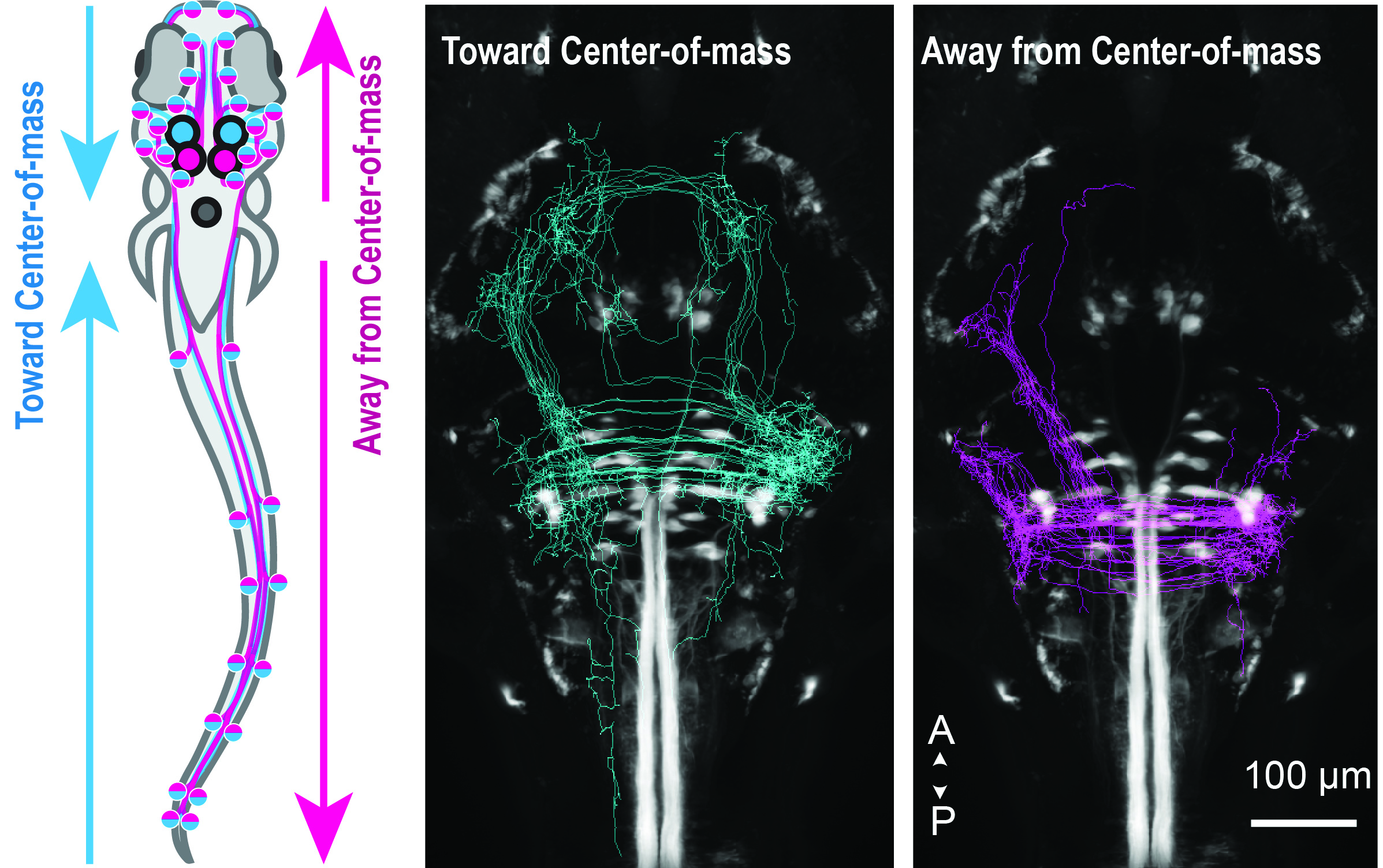
To understand how this map is positioned to influence behavior, Lunsford next examined how these neuronal groups connect to downstream circuits involved in movement. Using anatomical tracing and connectivity atlases, he reconstructed the projection patterns of direction-selective neurons. Signals directed toward the body center were found to project broadly and bilaterally to circuits associated with posture and forward propulsion, whereas signals directed away from the center preferentially targeted asymmetric circuits linked to steering and turning. These findings reveal a structured sensor-to-motor architecture that explains how directional cues across different body parts can preferentially route to circuits with distinct behavioral outcomes.
HFSP funding provided the freedom to pursue a high-risk, exploratory mapping strategy, which establishes a general framework for understanding how brains integrate spatial and directional information from distributed sensors into body-centered maps that support action selection. By providing a quantitative and anatomical blueprint of this transformation, this study opens the door to future investigations of how such maps are assembled across development, how they adapt as sensory inputs change, and how simple organizing principles can give rise to flexible behavior.