


































Bees, the essential pollinators of many crops and wild plants, are being exposed to increasing temperatures that could be affecting the way they buzz.
A bee’s buzz comes from the rapid contraction of their indirect flight muscles, which vibrate the thorax and move the wings during flight. However, the same muscles can produce buzzing sounds even when not flying and while the wings remain more or less motionless. These non-flight buzzes are used for communication, defence, and buzz pollination. While temperature is known to influence flight, its effect on non-flight vibrations is poorly understood. Understanding this relationship is important for predicting how climate change may alter bee behaviour, pollination effectiveness, and muscle biomechanics, as well as for improving acoustic monitoring tools such as AI systems trained on bee sounds.
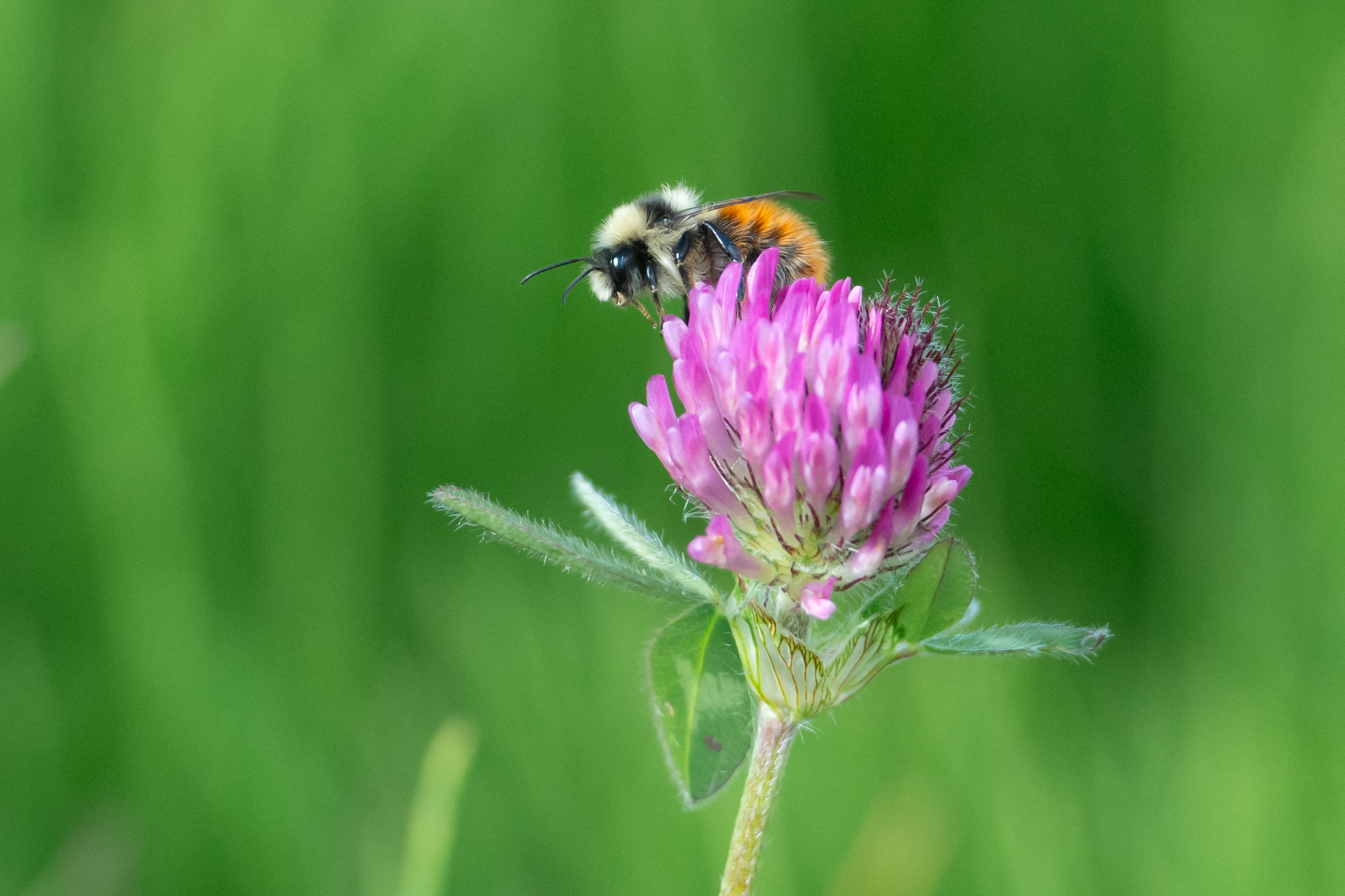
HFSP Research Grant awardee Mario Vallejo-Marin and his team examined how temperature affects non-flight buzzing in Arctic bumblebees, which are experiencing rapid climate warming due to Arctic amplification. Arctic species may be cold-adapted making them potentially sensitive to unusually warmer temperatures. Their study was conducted in the Swedish Arctic, in a region in which bumblebees are relatively abundant and important as pollinators, and during a particularly warm summer period.
To measure bee buzzes, the scientists used a miniature accelerometer which is a sensitive device that measures vibrations. They captured bees in the field, and placed the accelerometer against their thorax. Then they induced bees to produce defensive (non-flight) buzzes. For each buzz the researchers measured peak acceleration amplitude, frequency (pitch), and duration. Data were collected both during field surveys and in a portable temperature-controlled chamber.
Vallejo-Marin and his colleagues managed to collect and analyse over 14,000 non-flight buzzes from 15 bumblebee species, including very large northern species such as Bombus hyperboreus and B. balteatus, and the charismatic B. polaris. During buzzing, thorax temperatures reached up to 44 °C, much higher than ambient conditions.
Using some of this data, the team generated thermal performance curves. Their results showed that buzz properties were best predicted by thorax temperature (especially when body size was included), while air temperature had weaker effects, reflecting bumblebee endothermy. Higher thorax temperatures produced higher-frequency buzzes, ranging from about 100–400 Hz and increasing roughly 10 Hz per °C. Peak amplitude occurred near 40 °C thorax temperature and around 25 °C air temperature. Arctic bees did not appear to differ significantly from other bumblebees in buzzing performance, suggesting conserved muscle physiology, though broader ecological impacts of climate change could still be harmful and further testing is needed.
Overall, the study demonstrates that temperature has strong effects on the type of buzz that a bee produces. Given that buzz properties are related to important ecological functions such as the amount of pollen that a bee can remove from buzz pollinated flowers, these results highlight temperature as central to understanding a range of phenomena from thorax biomechanics to ecological function.