


































Most people are familiar with chelicerates, even if the name itself is not immediately recognizable. Chelicerates are a major group of arthropods named for their first pair of limbs, the chelicerae, which often resemble pincers, as in horseshoe crabs, or may be modified into the fangs of spiders or the stylets of ticks. Chelicerates differ from the other major group of living arthropods, the mandibulates, which include crustaceans, insects, and millipedes. Mandibulates have a typically whip-like pair of antennae as their first limb pair and, importantly, possess mandibles used for feeding.
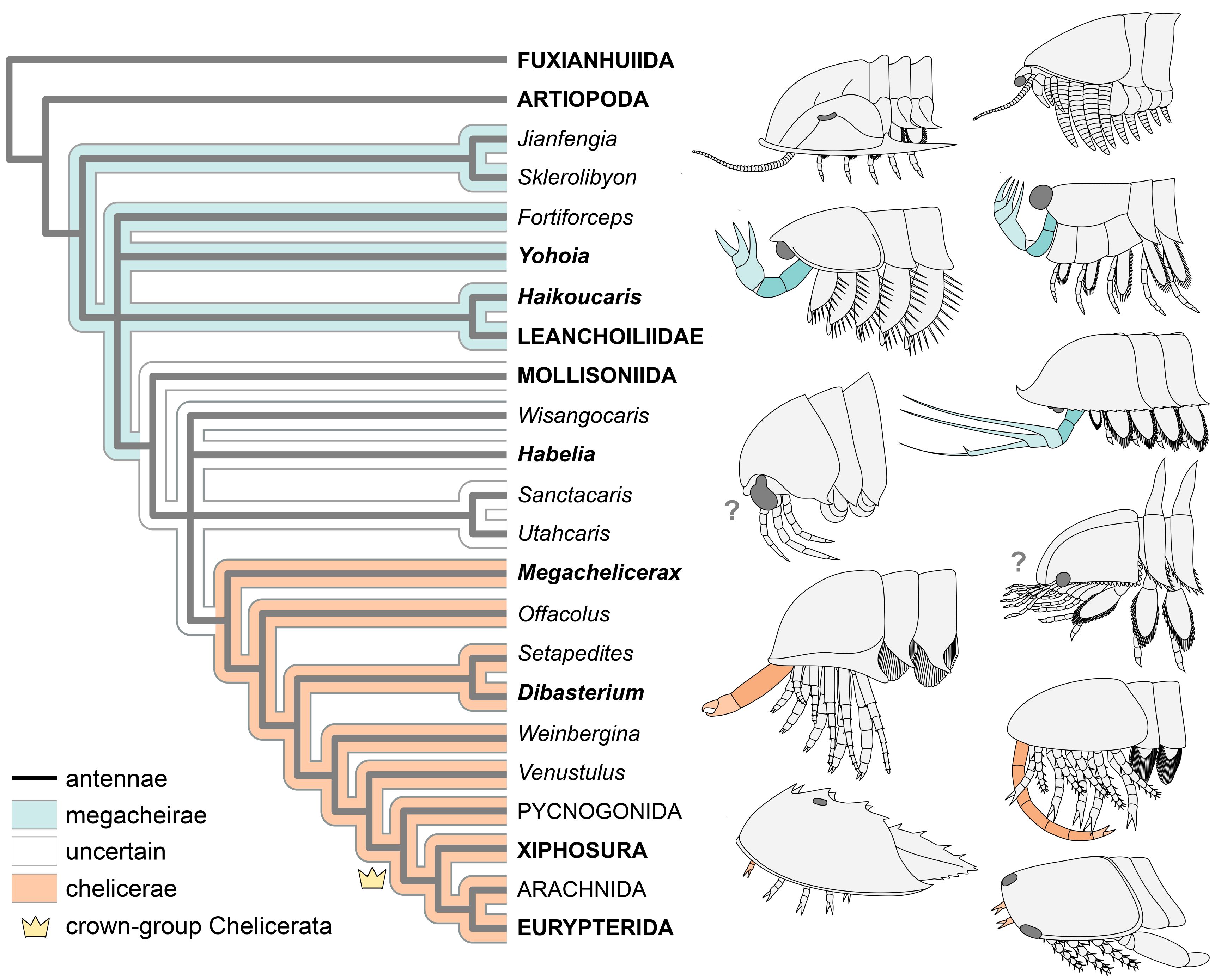
Both of these major arthropod groups originated during the Cambrian Explosion over half a billion years ago, an evolutionary event marked by the rapid diversification of animal life over a geologically short interval. While the fossil record provides clear evidence for diverse Cambrian mandibulates, the origin of chelicerates has been more elusive. Many types of Cambrian marine arthropods have been proposed as early chelicerate relatives, most notably biomineralized trilobites, and several groups of soft-bodied arthropods from exceptionally preserved fossil sites that share some features with modern chelicerates. Yet compelling evidence for Cambrian chelicerates has been lacking, chiefly because none of these early arthropod fossils clearly show chelicerae, the defining feature of this group.
A soft-bodied arthropod from the middle Cambrian (about 500 million years ago) of Utah helps fill a critical gap in our understanding of chelicerate origins. The Research Grant awardee Javier Ortega-Hernandez, and his team, investigated the evolution of arthropod gill morphology in depth. The researchers' data on the respiratory structures of horseshoe crabs and other marine arthropods were essential for interpreting the morphology and broader significance of Megachelicerax.
The HFSP research team found the new species, Megachelicerax cousteaui, is only 8 cm long, but preserves a spectacular pair of robust, pincer-like chelicerae extending in front of its head shield, demonstrating that chelicerates were already present during the Cambrian Period. In addition to its prominent pincers, Megachelicerax also clarifies several aspects of the body organization and evolution of early chelicerates. For example, it indicates that the archetypal six pairs of head limbs that characterize modern chelicerates were already in place during the Cambrian. Likewise, the head and trunk bear limbs with different functions: the head limbs are specialized for feeding, walking, and sensing the environment, whereas the trunk limbs are modified into flattened, gill-like structures that were likely used for respiration and swimming.
The discovery of Megachelicerax has broader evolutionary implications. It demonstrates that Cambrian chelicerates were large-bodied predators, which falsifies the hypothesis that their apparent lack of fossils is due to them having been very small at the time. The transitional morphology of Megachelicerax also helps link diverse Cambrian arthropods, including early-branching offshoots of the chelicerate tree, even when they lack direct evidence of pincer-like chelicerae, to unequivocal post-Cambrian forms such as horseshoe crabs and sea scorpions.
Finally, Megachelicerax and its relatives indicate that although chelicerates already had a relatively modern organization during the Cambrian, they did not become an ecologically dominant group until much later, when they colonized terrestrial environments. This delayed success suggests that, despite the appearance of key morphological innovations, environmental context plays a critical role in shaping the evolutionary history of animal lineages. In this context, this new Cambrian species provides an important reference point for the origin of book gills, a core component of the chelicerate body plan found in horseshoe crabs today.