


































Coacervates are liquid droplets that form spontaneously when a mixture of molecules reaches certain conditions: molecular interactions become strong enough, or concentrations become high enough. In that sense, they are the perfect candidates for the first cell-like structures on Earth. A major hypothesis proposes that organic molecules in a primordial ocean, such as polypeptides and polysaccharides, could have formed coacervates; that would then take up other molecules and serve as reaction hubs that synthesize growingly complex molecules. But this poses a paradox: if coacervates only form from macromolecules, what synthetic problem would they be solving in the first place?
Recent work by HFSP Research Grant Awardee Claudia Bonfio and her colleagues addressed this paradox by studying minimalistic coacervate compositions. Unlike previous studies that focused on single peptides capable of liquid–liquid phase separation, her team investigated compositions compatible with early Earth scenarios: likely a mixture of short peptides and short nucleic acids. The team screened over 500 combinations of peptides and nucleic acids, searching for those that formed droplets of reasonable stability. This extensive search showed that arginine-rich tripeptides and DNA octamers (much shorter than anticipated) are sufficient to obtain coacervates, and that mixtures with excess peptide form the most stable droplets towards salt and temperature stress.
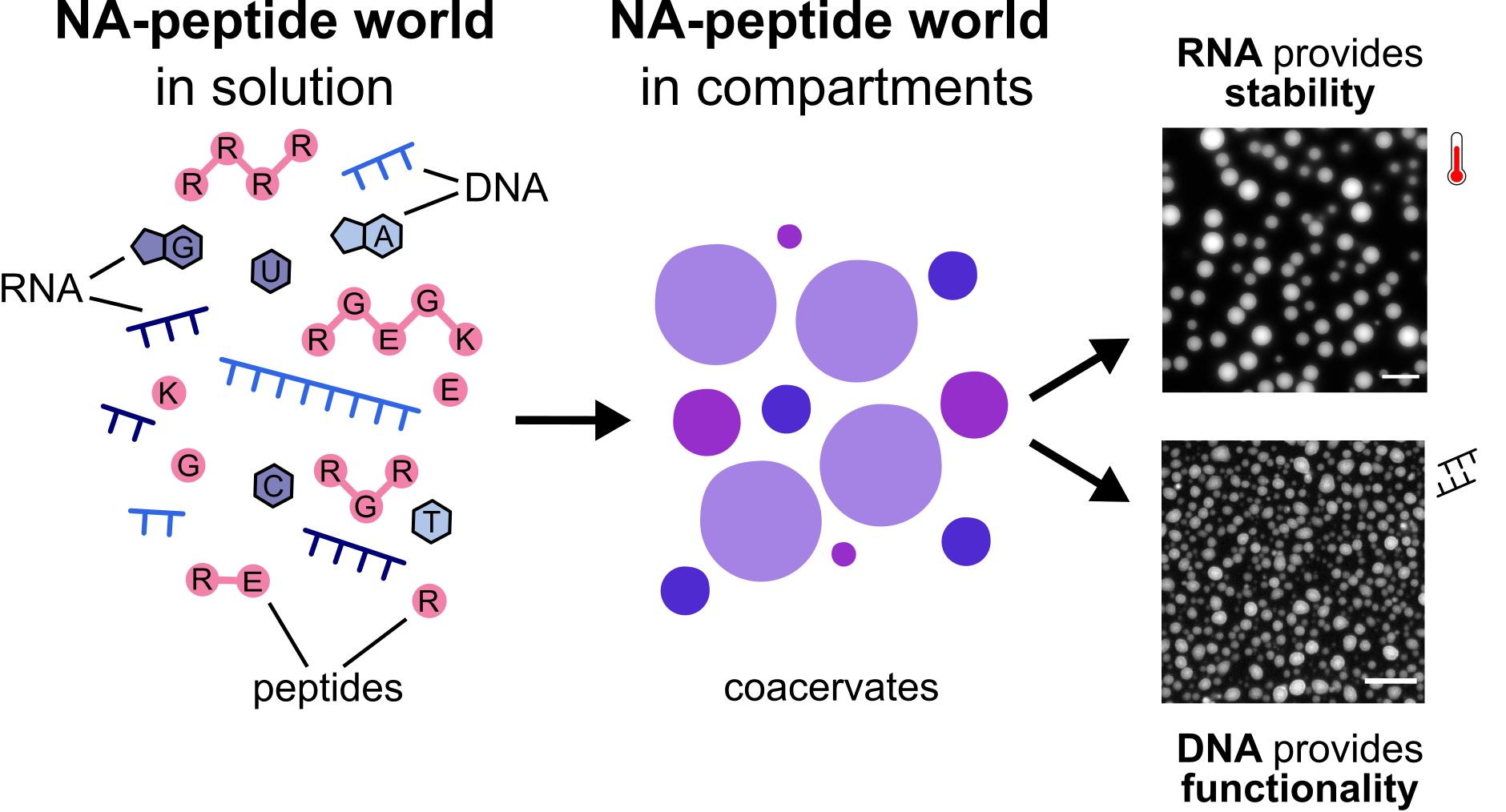
DNA was initially used as proxy for RNA: it is more readily available, and it only differs by one hydroxyl group, although RNA is thought to have been the first nucleic acid synthesized on early Earth. Bonfio's team discovered that replacing DNA with RNA caused a doubling in stability. To explain how a small structural difference can have such a large impact at the mesoscale, the scientists reached out to Rosana Collepardo's group in Cambridge to perform atomistic-level simulations of the peptide/nucleic acid mixtures. Together, they found that single-stranded DNA has a much more compact conformation than RNA, which reduces the average number of contacts a nucleotide in the chain can establish with a short peptide chain.
The team then probed whether the coacervates that formed could support RNA replication. Non-enzymatic RNA primer extension is a challenging chemistry dependent on reaction and diffusion steps, but crucial for the formation of longer, coded RNA sequences. Bonfio's team showed that peptide/DNA coacervates can support primer extension, and that high viscosity is the main cause of low primer extension yields in peptide/RNA coacervates.
Altogether, this work, funded by an HFSP Early Career Research Grant, highlights that phase separation was likely an inevitable process in the primordial ocean, and that coacervation can have a significant impact on prebiotic reactions previously thought to be unattainable. These findings bring a new perspective on the genetic takeover from RNA to DNA, and the minimal coacervate developed here can be easily combined with different protocell models to investigate synergistic effects.