


































Cells rely on exocytosis to grow, remodel their surfaces, and communicate with their environment. Before a cargo-filled vesicle can merge with the cell membrane, it must be “tethered” at the right place for fusion to occur. The exocyst protein complex is known to be the key tethering machine, but a major missing piece has been how multiple copies of this complex work together to control each vesicle delivery event.
To address this, the HFSP Research Grant team combined complementary imaging approaches. They used single particle tracking to characterize fluorescent temporal rulers that let them follow exocytic events over time, super resolution microscopy to measure the molecular organization at the nanoscale and cryo-electron tomography to image the membrane geometry inside intact cells. To uncover the concerted action of multiple exocysts, the team built a time-resolved view of single delivery events by integrating data from the three microscopy techniques.
Working in yeast, the HFSP Research Grant team first quantified how many exocyst complexes participate in a typical event and found that, on average, about seven copies gather around each vesicle. They then used super resolution microscopy and modeling to infer how those copies are arranged in space and time as the vesicle undergoes the last stretch towards the membrane.
The central finding was that these exocyst copies assemble into a flexible ring-like structure rather than a simple patch. Importantly, this ring, which the researchers named ExHOS (Exocyst Higher-Order Structure), is not static: it expands radially as exocytosis progresses, consistent with a mechanism that helps pulling the vesicle closer to the membrane through the central cavity of the ring. By time-ordering membrane distances, the team found that the cargo-loaded vesicle does not follow a linear movement. Instead, it advances in a stepwise manner, with three preferred “pause points” at roughly 27, 18, and 5 nanometers from the membrane. This reveals a time-resolved picture of how tethering actively guides a vesicle into a fusion-ready position.
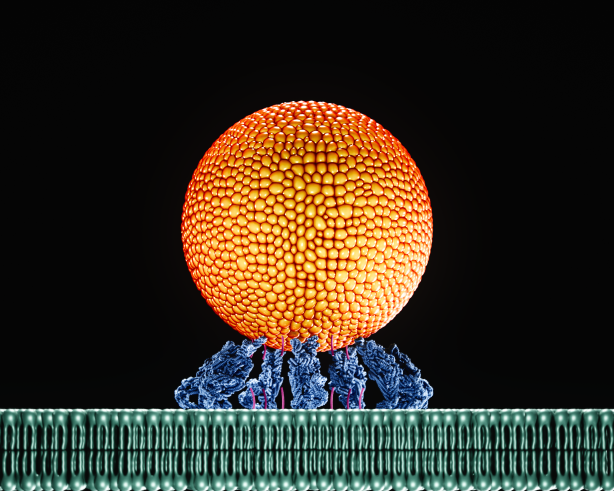
Finally, the scientists investigated how the cell resets the system after fusion. They found that a recycling factor called Sec18 is required to dismantle the expanded ExHOS once fusion has occurred. In fact, timely disassembly of the tethering machinery is not just cleanup; it helps set the pace of exocytosis by refilling the levels of exocysts that can assemble into fresh “contracted” ExHOS for the subsequent delivery event. More broadly, this work provides a quantitative blueprint for how dynamic, multi-copy protein assemblies can choreograph membrane trafficking in living cells.