


































The pollen and spore fossil record is one of the most abundant archives of past life available for study. Changes in species abundance and their distribution through time have been used to track how the biosphere has responded to perturbations in the climate and carbon cycle that have driven past mass extinction events. For example, the discovery of a fern spore abundance spike recovered from sediments just above the Cretaceous Paleogene boundary in North America was instrumental in framing our understanding of the terrestrial response to the impact event that drove the extinction of the non-avian dinosaurs.
More recently, scientists have noted that, along with taxonomic loss, these events were also accompanied by an increase in the abundance of malformed spores and pollen grains. These malformations manifest themselves as either changes to the overall size and shape of the grain and/ or as finer-scale disruption to the grain’s ornamentation. There is also evidence for a change in pollen and spore colour during these intervals of biodiversity loss. Through a combination of experiments on living plants, palaeobotanical and biogeochemical analysis, the HSFP Research Grant team has been trying to determine drivers of pollen and spore malformations as a tool to detect stresses and potential drivers of mass extinction events.
A recently published paper by HFSP Awardees focused on one aspect of these findings by investigating pollen and spore colour. Specifically, the researchers tested whether variations in colour could be induced through combustion, as an increase in wildfires is often associated with mass extinction intervals. To test this hypothesis, the team investigated how pyrolysis impacted spore colour, chemistry and size. Spores from club moss plants (Lycopodium) were combusted across a wide range of temperatures (150–800 C). Data showed clear changes in colour, with spores gradually changing from pale yellows through oranges and browns to near-black as the pyrolysis temperature increased.
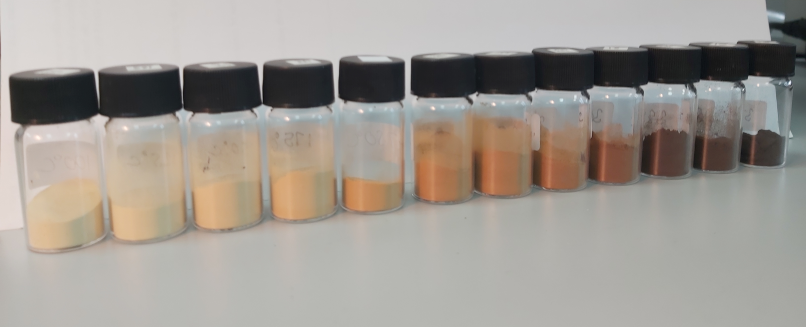
These colour changes were also quantifiable using image analysis to measure red, green and blue (RGB) intensities of individual spores, providing a repeatable measure of spore colour. As spores darkened, they also shrank. These physical changes were accompanied by changes in spore chemistry with clear clustering of chemistry that relates to combustion temperatures.
Collectively, the HFSP Research Grant team's analyses suggest that the colour variations observed in fossil pollen and spores associated with mass extinction events may be attributed to increased wildfire activity during these periods. With changes in colour reflecting varying degrees of heat exposure.