


























HFSP Research Grant awardees Adrien Sicard and Christina Grozinger and their colleagues provided the first clear evidence that a solitary bee species, Megachile rotundata (commonly called alfalfa leafcutting bees), actively regulates their intake of macronutrients (specifically protein and lipids) when foraging. While previous studies from the Grozinger lab have shown such behavior in social bees (e.g., bumblebees), the current results extend the nutritional geometric framework (NGF) to solitary bees, which represent the vast majority (>90%) of bee species. This closes an important gap in the understanding of how different types of bees manage their diets in complex natural environments.
Because pollen, the main food resource for bees, exhibits wide variation across plant species in protein and lipid content, the ability of bees to detect and adjust intake toward a preferred protein:lipid (P:L) ratio may be critical for their survival and reproduction. Using semi-field foraging trials with genetically controlled Capsella plant lines (created by Sicard et al. at Swedish University of Agricultural Sciences, Uppsala), and controlled lab feeding assays within the NGF, researchers showed that M. rotundata performed best, in terms of total consumption and survival, on diets with intermediate P:L ratios. This suggests that bees are not simply trying to maximize one nutrient (e.g., protein) at all costs, but instead are balancing trade-offs among nutrients to hit a physiological “sweet spot.” Such regulatory behavior can help buffer individuals against nutritional stress when the environment (flowering plants in the field) presents suboptimal or highly skewed nutritional options.
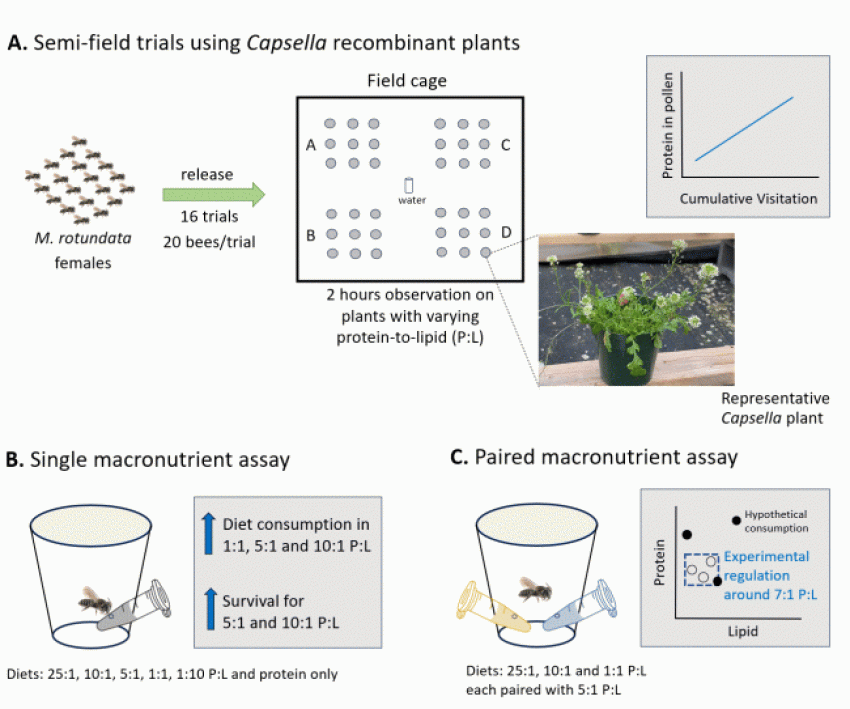
From an ecological and conservation perspective, this finding matters because it provides mechanistic insight into how plant–pollinator networks may evolve and function. If bees preferentially forage on, or perform better with, pollen of certain macronutrient ratios, then the distribution and abundance of plant species and their pollen composition could influence pollinator fitness, community structure, and even plant reproduction via pollination services. In other words, landscape composition and floral diversity might not just matter in terms of quantity of pollen or flower morphology, but also in terms of nutritional quality. This insight can refine how we think about habitat restoration, floral plantings, and pollinator-friendly strategies: ensuring a diversity of plants that together span a range of favorable nutrient mixtures might improve conditions for solitary bees.
Finally, because solitary bees often differ in life history, nesting behavior, and foraging range from social bees, demonstrating nutrient regulation in solitary bees suggests that nutritional ecology could be a broadly applicable framework across many bee species. Understanding such nutritional mechanisms is crucial in an era of habitat loss, climate change, and shifting flowering phenologies. These findings underscore that maintaining or restoring floral resources is not just about providing “food”, but providing the right kind of food that complements bees' needs. In turn, this can help improve resilience, reproduction, and population stability for a wider array of pollinators.
This work is part of a multi-disciplinary HFSP project entitled “Friends with benefits? A holistic approach to diffuse mutualism in plant-pollinator interactions”.