


































What determines the size of a plant? Starting from just a few cells, each root, stem, leaf, and flower follows a precise developmental path. Yet anyone who has tried to grow a few vegetables knows that no two plants are exactly alike. This natural variability makes it difficult to visualise and predict what “normal” growth rates look like for different organs, even in well-designed and carefully controlled studies.
In a recent study, a group led by the HSFP Grant Awardee Anne-Lise Routier-Kierzkowska compiled data from 176 published articles on Arabidopsis thaliana, a model organism widely used in plant biology, to create the first atlas of its growth. Published in the journal New Phytologist, the study analyzes growth across different organs such as leaves, roots, hypocotyls, and meristematic tissues, and across multiple phases of plant development.
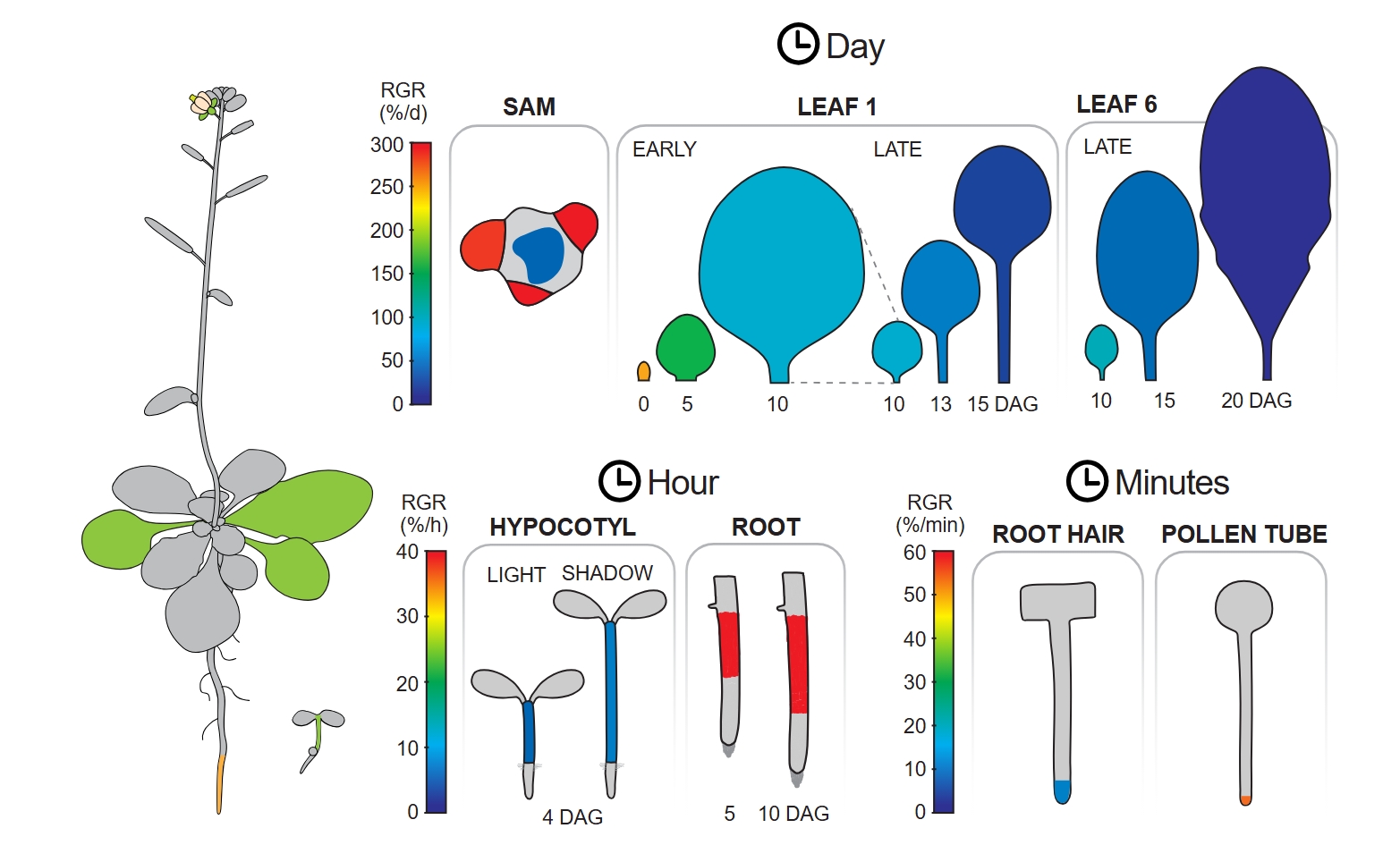
To achieve this, the group established a common mathematical framework that allowed them to convert and compare data from different organs and scales. With this consistent dataset in hand, they then explored which intrinsic and environmental factors contribute to differences in growth rates and final organ sizes. Each organ follows a distinct strategy to control how fast and how long it grows. For example, root growth relies mainly on the rapid expansion of a specific region, while leaves and stems grow very quickly at early stages before slowing down to a steady rate until they reach their final size. Notably, the very earliest phases of development, still poorly understood, appear to have a strong influence on final organ size. More in-depth studies of these stages could therefore open new avenues for improving agricultural traits.
The study also presents its findings as a clear, intuitive map of plant growth. By integrating different organs, timelines, and spatial scales, this atlas is designed to support future research, whether comparing mutant phenotypes, planning new experiments, or building models to better understand how plants grow and adapt to their environment.