


































According to the RNA world hypothesis, RNA has been a major player in the origin of life, supporting both roles of information carrier and catalyst. Central to this idea are RNAs capable of self-reproduction, where certain RNA sequences have the property to fold and accelerate reactions that assemble more copies of themselves from smaller pieces. This process is called autocatalysis and supports rudimentary forms of self-reproduction.
The HSFP Research Grant Team, composed of researchers from Ecole Supérieure de Physique et Chimie Industrielles (Paris, France), Max Planck (Leipzig, Germany), Boise State University (USA), the National Center for Biological Sciences Bangalore (India), and Sorbonne University (Paris), aimed to investigate whether many RNA sequences are capable of self-reproduction, knowing this is important in several regards. First, the more RNA sequences can self-reproduce, the more likely they are to appear in a primitive soup made of essentially random sequences. Second, for evolution to start, it is necessary that certain self-reproducer help the formation of others, which is only possible if there exists a variety of them. However, at the moment, only a few such RNAs are known, as they have been rationally engineered in the laboratory.
To address the question of the diversity of self-reproducing RNA, we took inspiration from RNAs found in known organisms, namely ‘group I intron’, which cleave themselves from messenger RNAs, the carriers of genetic information. Indeed, group I introns are catalysts for reactions between RNAs, and it had already been demonstrated that this activity is sufficient for their self-reproduction from smaller pieces.By training statistical models that learn the patterns of sequence variations of group I introns across organisms, and combining this information with structure prediction from physics, the researchers were able to design and test experimentally tens of thousands of highly diversified RNAs of length 200, which are not found in nature, but mimic the function of natural ones.
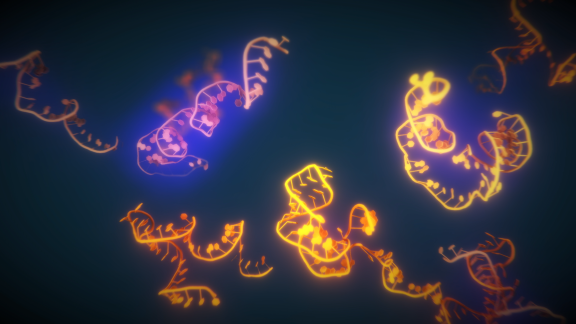
Based on statistical physics techniques and experimental success rates, HFSP Awardees could estimate the number of such RNAs to be at least of 10³⁹, an astronomical number of possibilities. As scientists have, in any case, only explored a tiny fraction of all possibilities, the study, published in Nature Communications, suggests that there exists a very large diversity of self-reproducing RNAs, further strengthening the possibility of a primordial life based on RNA.