


































Metabolic pathway engagement is not uniform across all cells, rather, different cell types preferentially engage in some metabolic pathway configurations over others. This metabolic heterogeneity allows cell metabolism to be fine-tuned to the metabolic demands of specific cell types and changing nutrient environments. A central metabolic pathway is the tricarboxylic acid (TCA) cycle, a hub of nutrient breakdown and energy generation. Despite the TCA cycle’s central role in the provision of metabolic intermediates, mammalian cells display surprising heterogeneity in their TCA cycle engagement and configuration. For example, some reactions of the TCA cycle can run in reverse or can be skipped by interconverting TCA cycle intermediates in the cytosol. The factors and contexts that dictate how the TCA cycle and related pathways remain poorly understood.
HFSP Long-Term Fellowship awardee Julia S. Brunner and her colleagues at the Memorial Sloan Kettering Cancer Center in New York have now published two studies outlining context-dependent engagement of the TCA cycle and its connected metabolic pathways. In the first study, the authors set out to ask why many cells in culture do not necessarily engage the full set of reactions that make up the “canonical” TCA cycle. They found that increasing cellular nutrient consumption also increased citrate production, the metabolite formed in the first step of the TCA cycle. Enhanced citrate production dictated forward flux through the TCA cycle and induced dependence on enzyme aconitase 2, which catabolizes citrate in the TCA cycle. In a mouse model of inducible aconitase 2 deficiency, they further found that the kidney is uniquely sensitive to aconitase 2 loss due to its capacity to uptake circulating citrate. This work demonstrates that apart from its known roles in nutrient breakdown and provision of metabolic intermediates, the TCA cycle is also essential for metabolite clearance.
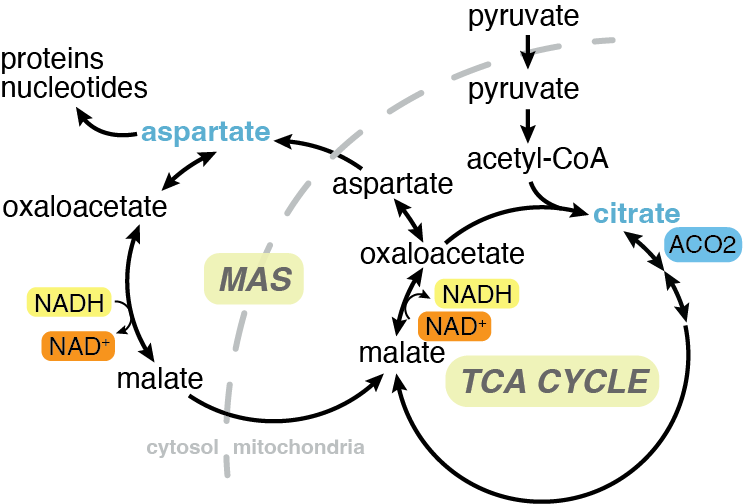
(Right) In instances of increased pyruvate influx into the mitochondria, citrate production increases. The accumulation of citrate induces TCA cycle flux and further renders cells dependent on aconitase 2 (ACO2) to catabolize citrate."
In the second study, Brunner and colleagues described how pathways that funnel electrons from the cytosol into the mitochondrial TCA cycle are dependent on cell state. Specifically, a pathway known as the malate-aspartate shuttle, carries nutrients between the cytosol and mitochondria, filling up the TCA cycle with metabolites whose cytosolic accumulation would otherwise impair cell metabolism. Here, the scientists found that it is the availability or absence of a substrate – in this case, the amino acid aspartate – that determines whether cells can engage the malate-aspartate shuttle. Manipulating the availability of aspartate using expression of aspartate-consuming or -producing enzymes allowed them to tune malate-aspartate shuttle flux and to induce connected metabolic signatures of proliferating or differentiated cells, respectively. This study demonstrates that cell-state specific demands for aspartate determine the degree to which cells can use the malate-aspartate shuttle.