


































Leaf-cutter bees are a globally widespread family of solitary bees, known for using leaves and other materials to build nests. They also differ from many other bees in that they pack pollen in hairs on their abdomen rather than on their legs like honeybees and bumblebees. However, the evolution of these unique behaviors remains difficult to reconstruct because fossils rarely preserve evidence of animal behavior or ecology. Now, an exceptionally preserved species trapped in amber is providing a remarkable glimpse into the lives of some of the earliest leaf-cutter bees.
Using synchrotron X-ray tomography, the HFSP-supported team from Uppsala and Stockholm Universities investigated a piece of Baltic amber, dating back to around 48-34 million years ago. Inside, they found a new species of bee, named Protolithurgus acarophorus. Exceptional preservation allowed the researchers to examine not only the bee's morphology, but also pollen, mites, and the geometry of its flight muscles.
One of the most striking discoveries was the presence of compacted pollen in the hind leg hairs. Most living leaf-cutter bees carry pollen primarily on specialized hairs on the underside of the abdomen, so the presence of pollen-bearing structures on the hind legs reveals how pollen collecting methods have changed over time. Within these hairs, and across the body, the team identified almost 15,000 possible pollen grains. Larger, recognizable pollen grains included pine and cedar, while smaller pollen-like structures may have originated from plant families such as birches, beeches and oaks, although these identifications remain tentative because of the limitations of imaging resolution.
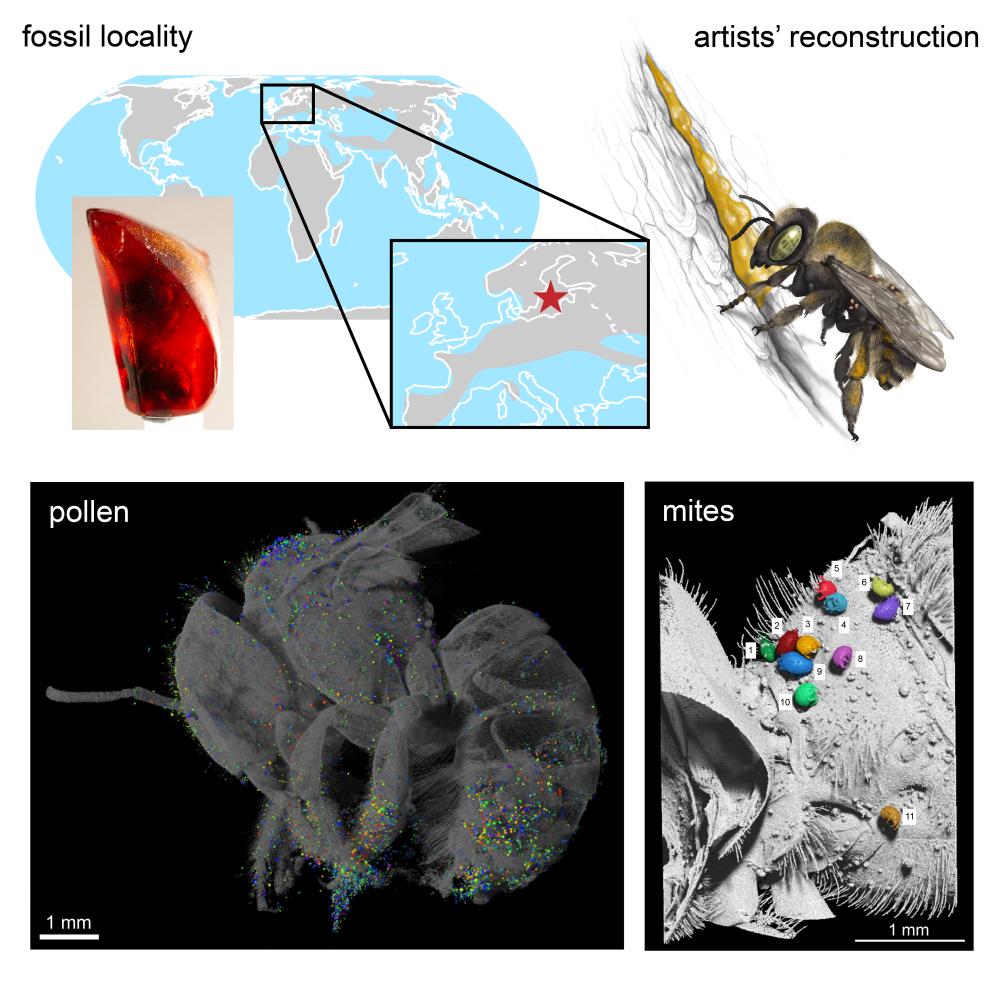
The researchers also suggest that P. acarophorus may have collected resin from coniferous trees for nest construction, as many living megachilid bees do, which ultimately led to being captured in amber (which is fossilized tree resin). Together, the pollen and amber evidence paint a detailed picture of the warm, forested environments of the Baltic region during the Eocene.
The bees were also not alone in the amber. Twelve tiny mites, belonging to a group known as the Astigmata, were found attached to one of the bees, mostly at the connection between the thorax and abdomen. Their specialized attachment structures indicate that they are phoretic deutonymphs: a life stage in which mites hitchhike on another animal to reach new resources.
This discovery represents the first definitive fossil association between bees and mites. The mites themselves also appear less specialized for attachment than many modern bee-associated mites, potentially offering clues about how these associations evolved. The name of this fossil bee species ‘acarophorus’ translates to ‘mite-loving’ or ‘mite-carrying’, in reference to this unique association.
The 3D scans also uncovered the geometry of the bee's internal flight musculature. Although the muscles themselves were not preserved, the spaces occupied by the muscles retained enough anatomical information for the researchers to estimate a maximum muscle force of approximately 0.05–0.06 N, consistent with predictions based on the bee's thorax size. The team also used measurements of the thorax size of living bees to estimate how far this fossil species could have travelled to forage for plant materials.
The study highlights the extraordinary potential of high-resolution synchrotron tomography for revealing the biology of organisms preserved in amber. As higher-resolution imaging and three-dimensional datasets from living bees become available, similar approaches could transform our understanding of how the ecology, behavior and biomechanics of bees have evolved through deep time.