


































A male sperm whale fires a powerful click into the surrounding ocean. Then it waits. Several seconds later comes another click, followed by another, each separated by an interval so long that a human listener might struggle to anticipate the next beat.
The animals produce these “slow clicks” at just 0.1 to 0.3 hertz—roughly one every 3 to 10 seconds—yet maintain the rhythm with extraordinary precision. The signals may travel as far as 70 kilometers and appear to be the loudest communication calls produced by any mammal, researchers reported this year.
For Andrea Ravignani, a comparative psychology researcher at Sapienza University of Rome, the most immediate mystery is how an animal’s nervous system generates such a glacially slow but steady pattern.
“The fact that an animal is producing something very regularly at a repetition rate which goes beyond any oscillation we typically study in the brain—it’s puzzling,” he says. “What’s the mechanism?”
Ravignani highlighted the slow clicks at the HFSP Awardees Meeting in Geneva in July. They are among the phenomena explored through an HFSP Research Grant, “The Social Origins of Rhythm,” a collaboration involving Ravignani, dolphin biologist Stephanie King of the University of Bristol, sensory physiologist Peter Madsen of Aarhus University, and comparative neuroscientist Peter Cook of New College of Florida. The team combines studies of cetacean cooperation, pinniped vocal learning, and brain circuitry to ask how keeping time became a tool for social interaction.
“Of the building blocks of human rhythm, we can find each and every one in at least one species,” Ravignani says. Some appear to correlate with sociality. “The full package might be uniquely human, but so is the full package for many other things.”
Rhythm research has traditionally concentrated on songbirds and primates. But songbirds are evolutionarily distant from humans, whereas most nonhuman primates have limited control over their voices. Marine mammals combine unusual vocal flexibility and breathing control with societies ranging from largely solitary lives to stable alliances and multigenerational clans.
“Nature has given us this natural experiment,” Ravignani says. One possible starting point is the control of breathing. For most terrestrial mammals, calling is closely coupled to a largely automatic respiratory cycle. Marine mammals must instead decide when to breathe, hold their breath through long dives, and carefully manage air passing through their sound-producing organs.
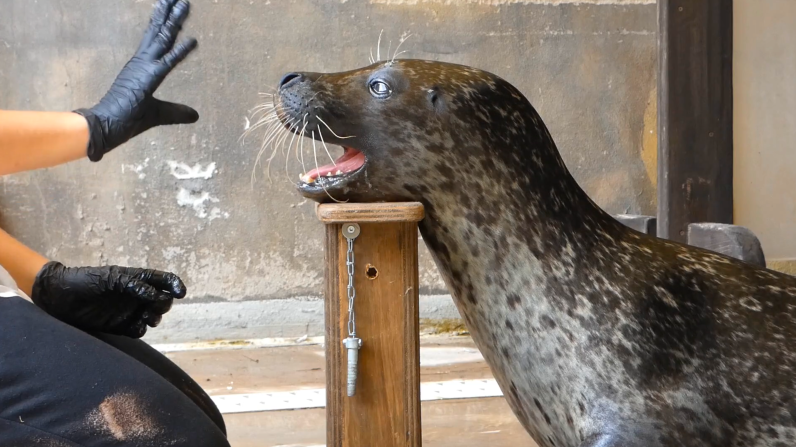
Ravignani cautions against a simple scenario in which diving produced breath control and social pressures converted it into rhythm. Flexible rhythm may instead have required several capacities – from voluntary control of breathing and sound production to the ability to perceive temporal patterns – to evolve in parallel and then be recruited together.
Other experiments suggest harbor seals can adjust pitch and alter the shape of the vocal tract while calling. Hoover, a seal raised by a Maine fisherman, even reproduced fragments of human speech. Taken together, the findings suggest seals can exercise unusual control over breathing, the larynx, and the upper vocal tract—the three principal systems involved in sound production. “Harbor seals and gray seals seem to be able to control all three systems independently,” Ravignani says.
Brain anatomy may help explain that versatility. A recent Science study found strong connections between cortical vocal areas and brainstem regions controlling phonation in seals and sea lions, but not in coyotes, which are fairly close land relatives of seals. Harbor seals also had enhanced circuitry resembling pathways involved in vocal learning in humans and birds. Ravignani calls the convergence “a deeply beautiful biological thing.”
Possessing the machinery for flexible vocal control, however, does not show why an animal uses rhythm – or whether social pressures shaped its deployment. Male bottlenose dolphins, for example, coordinate movements with longstanding allies and sometimes synchronize vocal signals. Such timing might help maintain bonds vital to cooperation. But the direction of causation remains unclear. “Does synchrony cause bonding, or does bonding cause synchrony?” Ravignani asks.
Harbor seals also produce rhythmic signals without using their voices. Juveniles and adults repeatedly strike the ground, their own bodies, or the water with a fore flipper. Land-based slapping during tense interactions can reach 200 to 600 beats per minute and is often nearly isochronous, with successive beats evenly spaced. Slower and more elaborate water displays are produced by adult males, suggesting a possible role in courtship or competition.
Yet it is not known whether another seal responds to the pattern itself, rather than simply to a loud splash or vigorous performance. “We don’t know whether the rhythmic structure of any of these is perceived by the receivers,” Ravignani says.
What sperm whale slow clicks communicate – and to whom – remains similarly mysterious. They may advertise a male’s presence or quality across great distances, but researchers cannot yet say what information the timing conveys.
Because such calls are difficult to manipulate experimentally, Ravignani likens the researchers to astrophysicists searching for anomalies in distant signals. The HFSP team is combining field recordings, controlled experiments, and comparative brain studies, but data remain scarce: Tagging a whale can require an expedition, and teaching a sea lion a new behavior can take more than a year.
“By necessity, we are slightly undersampled,” Ravignani says. That challenge makes the project’s mix of field biology, neuroscience, animal behavior, and music cognition especially valuable. HFSP, he says, enables “this kind of slightly crazy, but dreamy and ambitious research to happen.”
The next clue may come when researchers discover whether a sperm whale listening kilometers away answers the slow clicks in time.