


































Scientific discovery increasingly depends on collaboration across disciplines, institutions and borders. At the Human Frontier Science Program, this principle is built directly into the structure of the Research Grants.
The 2026 HFSP Research Grants connect scientists from 30 countries and nearly 100 institutions worldwide, forming international teams that span continents, research cultures and scientific expertise. From neuroscience and ecology to plant biology and biophysics, the projects supported this year reflect a global approach to tackling complex questions in the life sciences.
Many teams bring together researchers based in countries separated by thousands of kilometers, yet connected by shared scientific questions. One project investigating climate-driven ecosystem responses links scientists in Chile, South Africa, Portugal and the United States. Another exploring biodiversity and disease spillover connects researchers in Singapore, Cambodia, the United Kingdom and the United States. Across the portfolio, collaborations extend through Europe, Asia, Africa, Oceania and the Americas.
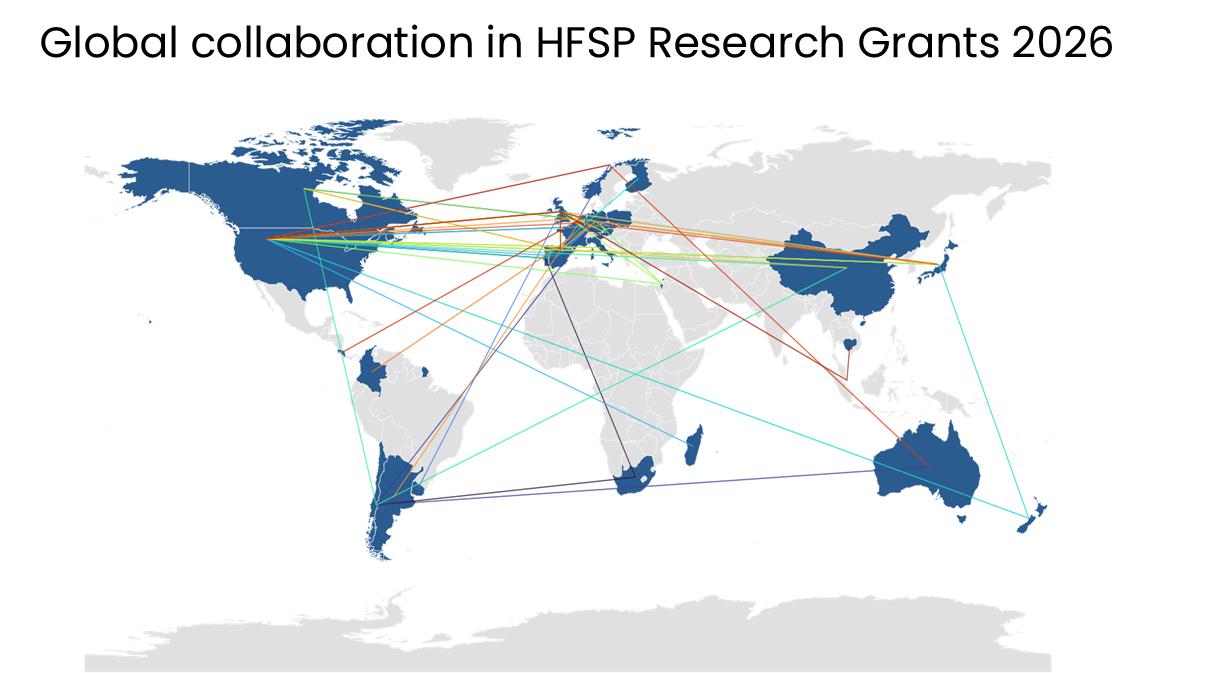
This international structure is central to the HFSP model. Research Grant teams are intentionally built across borders, encouraging scientists with different perspectives, methodologies and research environments to work together on ambitious, interdisciplinary projects.
The geographic diversity of the 2026 awardees also reflects the program's expanding reach. Alongside researchers in HFSP Member countries, scientists based in an increasing number of countries worldwide are contributing to collaborative teams, strengthening the global exchange of ideas and expertise.
Whether studying sleep, climate change, evolution, or cellular organization, the projects supported this year demonstrate that addressing the complexity of life often requires science without borders.
The 2026 HFSP Research Grants continue this tradition, supporting research that is global not only in scope, but also in the collaborations that make it possible.