


































The human sperm cell reminds us of our ancestry: a single-celled organism equipped with a flagellum, a whip-like tail that propels the cell forward. Flagella – or cilia – are found in almost all eukaryotes (= organisms more complex than bacteria), and their internal structure is conserved among all groups of eukaryotes, from the smallest single-celled ‘flagellates’ to plants and animals. Because of the shared complex structure of the flagellum, we can conclude that the last eukaryotic common ancestor (LECA), that lived more than one billion years ago, was a flagellate. All other complex life – plants, fungi, animals, and many other single-celled organisms – evolved ultimately from LECA. We study the very diverse morphology and functional ecology of representatives from the many groups of single-celled organisms to help us understand the early evolution of eukaryotes.
What did LECA, the common ancestor, look like, and how did it feed? Growing evidence points to a cell with two flagella, one of which is equipped with a vane, a ribbon-like structure. The vaned flagellum beats in a groove that runs along the length of the cell and creates a very efficient feeding flow into the groove. Bacteria carried with this flow are captured and consumed by the cell. This body plan survives today in several groups of single-celled organisms scattered across distant branches of the eukaryotic tree of life, and three of these groups, known as ‘typical excavates’, forage in the same way as we believe LECA did.
Here a team that was supported by an HFSP Research Grant studied excavate-like flagellates, drawn from two other branches that split apart early in evolutionary history. Like the typical excavates, they have a groove and a vaned flagellum that beats alongside it. However, they forage very differently: they are hunters that chase down their prey. And rather than on bacteria, they prey on organisms that are about the same size – or even bigger – than themselves. Instead of generating a feeding current, the hunters swim around until they physically collide with prey. On contact, they fire tiny harpoon-like structures that anchor the prey in place, sometimes even dragging a struggling victim closer before subduing it. The hunting flagellates then either engulf the prey by folding around it for digestion, or they may nibble pieces of the larger prey.
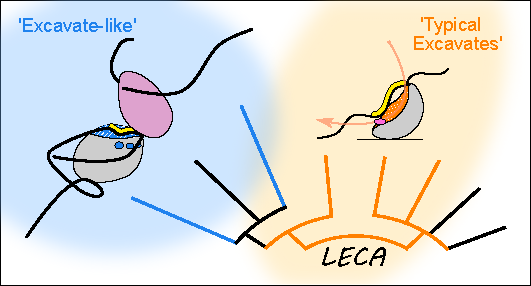
How can such similar morphologies be used in such different ways? The scientists explored this using fluid mechanical analysis and computer simulations. While the vane-and-groove morphology is a very efficient way of generating a feeding current in the stationary typical excavates, it turns out to be rather inefficient for swimming in the hunting flagellates when compared to simpler (naked) flagella beating without a groove. Is the vane-and-groove system in the excavate-like flagellates a vestigial trait that natural selection not yet has ‘got rid of’ (like the appendix in humans), or does it have adaptive value?
One advantage of the groove-and-vane system in the hunters is that it may help stick to the prey until the predator has fired its harpoon and has finally captured the prey. The beating vaned flagellum creates negative pressure in the groove that may help the predator to stick to and wrestle down large prey. A similar system is found in parasitic excavates that use fluid dynamics to cling to the gut wall of its host.
The groove-and-vane system may be homologous structures between the diverse deep branches of the eukaryotic tree, but anatomical evidence is still insufficient to draw firm conclusions. However, the fact that the five very distant branches of the eukaryotic family tree use their similar groove-and-vane apparatus in such different ways suggests that this ancient body plan may be remarkably adaptable. Tracing how one structure came to serve such different lifestyles helps to reconstruct early eukaryotic evolution and the evolutionary trajectory of living flagellates.