


































Every cell depends on membrane-bound organelles that perform specialized tasks. Among them, the Golgi apparatus occupies a central position by modifying, sorting and dispatching newly synthesized proteins and lipids throughout the cell and to the cell surface. The Golgi is remarkably dynamic: it expands during development, tissue repair and immune activation, fragments during cell division, and is disrupted in numerous human diseases. While coordinated transcriptional programs governing the biogenesis of several other organelles have been identified, whether a similar mechanism controls Golgi biogenesis has remained one of the fundamental unanswered questions in cell biology.
In this HFSP-supported study, a team of scientists addressed this question by developing an experimental system that transiently eliminates functional Golgi structures, allowing cells to rebuild the organelle from scratch in a synchronized manner. This unique platform enabled them to follow Golgi biogenesis from its earliest stages.
Combining this approach with single-cell transcriptomics, quantitative imaging, electron microscopy and functional analyses revealed that Golgi regeneration is accompanied by activation of a remarkably coordinated transcriptional program. Hundreds of genes encoding Golgi structural proteins, membrane-trafficking factors, glycosylation enzymes and other components of the secretory pathway were induced together as the organelle reformed. Rather than acting independently, these genes behaved as a unified regulatory network orchestrating Golgi assembly.
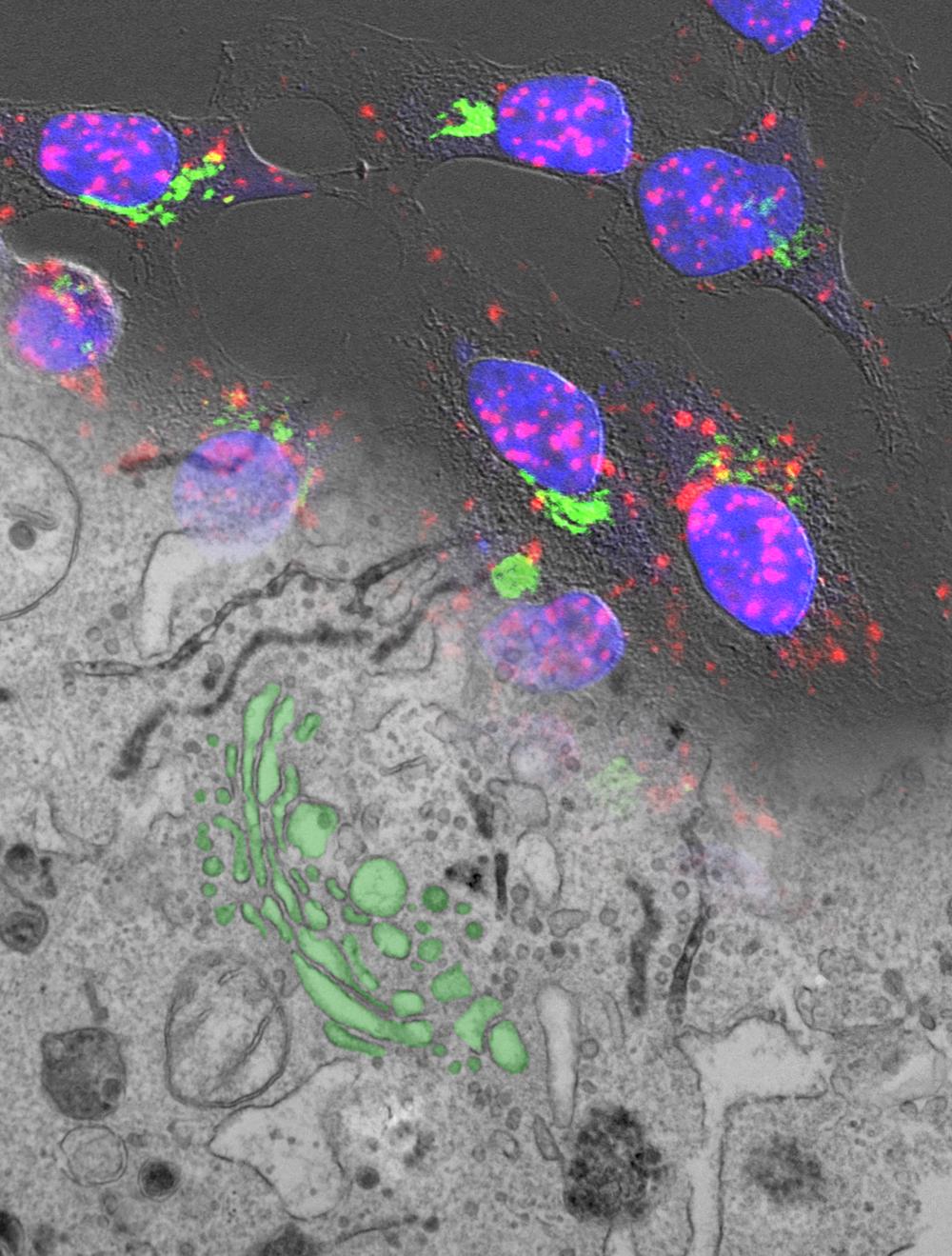
The researchers further identified the transcription factor CREB3L1 as a central regulator of this program. Loss of Golgi function activates CREB3L1, which enters the nucleus and stimulates expression of genes required for Golgi reconstruction. Inactivation of CREB3L1 severely impaired Golgi regeneration, demonstrating that transcriptional regulation is essential for rebuilding the organelle. These findings establish a new conceptual framework for organelle biogenesis. Instead of arising solely through spontaneous self-assembly, the Golgi apparatus is rebuilt through a genetically programmed process that coordinates the production of its many structural and functional components. This work identifies what the team termed a "Golgi regulon"—a coordinated set of genes dedicated to Golgi formation and function—and reveals a mechanism by which cells adjust their secretory capacity to changing physiological demands.
Because organelle remodeling accompanies development, differentiation, stress responses and many diseases, these findings provide a foundation for understanding how cells dynamically remodel their internal architecture. More broadly, the study illustrates how global transcriptional programs can direct the assembly of complex cellular structures.
Beyond its fundamental biological significance, deciphering the transcriptional program governing Golgi biogenesis opens new opportunities to manipulate Golgi function in a controlled manner. Because the Golgi apparatus plays a central role in protein processing and secretion, targeted activation of this program could offer new strategies to enhance cellular secretory capacity when increased Golgi activity is desirable. Such approaches may ultimately improve mammalian cell platforms used for the production of antibodies, recombinant enzymes for enzyme replacement therapies, and other biopharmaceuticals."