


































Engineered structures eventually fail under repeated stress — a process known as material fatigue. Yet neurons can function for an entire human lifetime, despite constant mechanical strain. How do these fragile cells preserve their structure and activity for over a century? What molecular mechanisms allow neurons to resist repetitive mechanical damage, and how do they detect, repair, or prevent failure over time? A project led by HFSP Research Grant awardees Henry Hess (Columbia University), Akira Kakugo (Kyoto University), Orit Shefy (Bar-Ilan University), and Vittoria Raffa (University of Pisa), together with their collaborators, set out to answer these fascinating questions.
When living neurons were repeatedly compressed with forces similar to those experienced in daily life, their internal cytoskeleton — formed by microscopic structures called microtubules — became twisted, fragmented, and disorganized. Axons, the long extensions that transmit nerve signals, also retracted, clear signs of cellular stress.
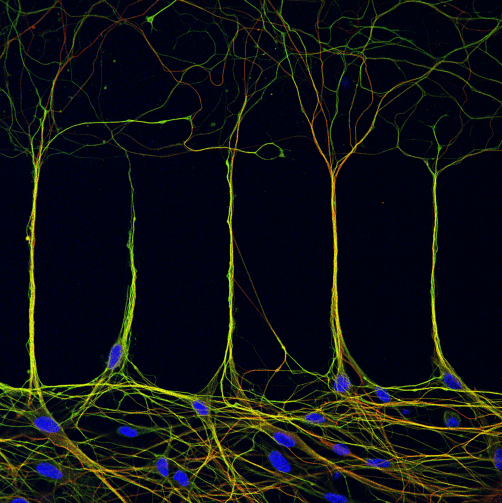
The key discovery by the HFSP-supported team was that neurons can actively recover from mechanical damage through a precise molecular repair program. Damaged cells restored their internal architecture by reactivating the Ras signaling pathway, a molecular system involved in cell growth and regeneration. Mechanical stress initially switched off Ras activity and destabilized microtubules through activation of the enzyme GSK-3β. But neurons responded to mechanical stress by increasing the expression of genes capable of reactivating Ras, allowing microtubules to regain stability and axons to recover their original structure.
By combining Kakugo’s pioneering work on microtubule fatigue, Shefi’s neuro-engineering approaches, Raffa’s studies in neuronal mechanobiology, and Hess’s vision of neurons as self-repairing machines, the collaboration supported by HFSP opened an entirely new way to explore the mechanical resilience of neurons. The team's findings reveal that neurons are not passive structures but dynamic, self-repairing systems that can detect mechanical damage and trigger molecular programs to restore their integrity. Understanding this resilience could open new strategies against neurodegeneration, nerve compression disorders, and traumatic injuries.