


































"Nobel prize winner, François Jacob, famously argued that “evolution is a tinkerer… it works with what is already there”. When tinkering with the brain, there is plenty that can go wrong. Brains are networks of networks, circuits built from delicate connections between specialised neural cell types. In large brained species these circuits can depend on the correct production and assembly of billions of cells, with the necessary connections between them relying on almost unimaginable numbers of synapses. How does evolution tinker with a system this complex?
One answer may be that neural systems retain their evolutionary adaptability so that selection may alter how information is processed in specific circuits, while retaining their interactions with downstream partners. This could allow behavioural change to occur by altering input to circuits that are less malleable, rather than tinkering with what those circuits do. In this way, brains may exploit the interconnectedness and interdependence of circuits to combine flexibility with robustness.
One way to explore this is by investigating how animals integrate salient, external sensory information – such as odor or vision - with information about their internal state, such as direction relative to a goal, or memories of past rewards. In insects, these processes are controlled by neural circuits that center around two particular brain areas: the central complex, the insect navigation center, and the mushroom bodies, the learning and memory center. These integration centers are essential for both reward-oriented behaviors; they are interdependent and interconnected. One striking example of how the evolution of these circuits can be linked to impressive displays of learning and memory comes from tropical butterflies called Heliconius. Heliconius have evolved the ability to memorize resource locations, visiting rewarding plants in a spatially and temporally faithful manner within a fixed home range. To support this memory-dependent behavior, Heliconius have evolved expanded mushroom bodies, comprised of 8 times more neurons than their close relatives.
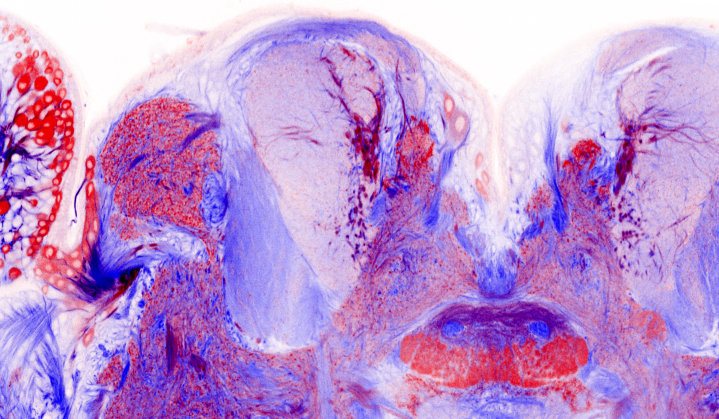
The international team supported by an HFSP Research Grant asked whether the derived learning and memory abilities of Heliconius evolve not just through an expansion of the mushroom bodies, but also through changes the central complex, its functional partner. So far, the evolution of mushroom bodies and the central complex have mostly been examined separately, despite their necessity to work together for flexible tasks such as spatial foraging. The extreme neural variation among Heliconius and their relatives uniquely allowed them to explore the co-evolution of both of these integrative centres in the context of a shared behavioural task, spatial foraging.
The researchers found that the two main integration centers of the insect brain, the mushroom bodies and the central complex, have taken two very different evolutionary trajectories to facilitate the cognitive processes that underpin Heliconius butterflies’ spatially faithful foraging behavior. Using a phylogenetically broad dataset of immunostained brains from 41 species, and a dataset of more specific stainings against key neurotransmitters in select focal species, they identified broad conservation of the central complex, directly contrasting with the major changes they observed in the mushroom body size and internal structure. However, despite this broad conservation, the scientists also identified specific, localized changes in the fan-shaped body, part of the central complex that has been linked to specializations in sensorily-driven navigation.
Importantly, this suggests that functional changes in neural circuits to support spatial memory in Heliconius may not have been limited to the mushroom body, but also implies that the dynamic evolution of the mushroom body may be dependent on the more conservative evolution of the central complex.