


































What connects sleep, robotics, plant communication and climate modeling? At first glance, not much. Yet these are just a few of the research areas supported by the 2026 HFSP Research Grants.
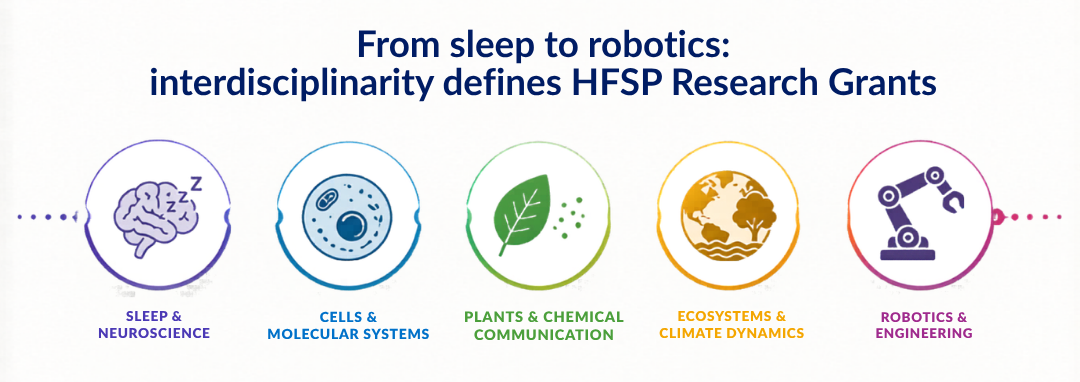
Interdisciplinarity lies at the core of the Human Frontier Science Program. Rather than focusing on a single field, HFSP supports projects that bring together different disciplines to address complex questions in the life sciences. The result is a portfolio of research that spans a remarkable range of topics, approaches and scales.
This year’s projects illustrate this diversity. Some explore fundamental biological processes, such as how sleep can be generated beyond the brain, or how cells store information and “remember” past states. Others investigate how organisms interact with their environment, from plant communication through chemical signals to the dynamics of ecosystems under climate change.
At the same time, many projects integrate methods and concepts from outside traditional biology. Robotics is being used to study subterranean ecosystems, while artificial intelligence and computational modeling are helping predict disease dynamics and ecological responses. Advances in physics and engineering are shedding light on how tissues form, how signals are transmitted, and how biological systems organize themselves.
Across these examples, what defines HFSP Research Grants is not a specific discipline, but the willingness to combine them. By bringing together scientists with different expertise, the program enables new ways of thinking about biological questions—often leading to unexpected insights.
From molecules to ecosystems, from neuroscience to engineering, the breadth of topics reflects a simple idea: addressing the complexity of life requires crossing boundaries.
The 2026 HFSP Research Grants highlight the power of this approach, supporting research that is interdisciplinary by design and global in scope, opening new directions for discovery across the life sciences.