


































T lymphocytes play a central role in the adaptive immune response by recognising foreign antigen peptides presented on the surface of antigen-presenting cells. Scientists have exploited the power of T cells to target tumours or infected cells that evade the immune system by exogenously expressing Chimeric Antigen Receptors (CARs). CARs are engineered receptors that mimic the endogenous T-cell receptor, and T cells equipped with specific CARs can be repurposed to recognise and bind specific epitopes present on the surface of cancerous or infected cells. Beyond the molecular components of T-cell signalling, it has become increasingly clear that T-cell topography also strongly impacts immune signalling. The surface of T cells is covered with a heterogeneous set of actin-rich protrusions that have been extensively proven to influence T-cell activation. However, it is not clear how the proteins involved in early T-cell signalling localise in this complex 3D topography before and upon contact with the target cell.
To address this, the HFSP Research Grant team employed CRISPR-Cas9 gene-editing to endogenously tag key signalling proteins such as the kinases Lck, ZAP-70, the adaptor LAT or the phosphatase CD45, and performed quantitative live-cell confocal and super-resolution [stimulated emission depletion (STED)] microscopy to develop a quantitative model of their dynamics and nanoscale redistribution during Human Epidermal Receptor 2 (HER2)-CAR-mediated activation at cell–cell contacts. CAR systems not only provide a powerful model to study early cell–cell interactions and the role of membrane topology and protrusions in signalling but also offer insights that could guide the improved engineering of CAR T cells for more effective cancer targeting.
One of the central findings was that, contrary to previous reports Lck, LAT, and CD45, do not show any preferential enrichment in, or exclusion from, actin-rich protrusions before activation. This random localisation likely supports T cell homeostasis in the absence of a specific stimulus. However, once the T cell engages its target, the role of actin-rich protrusions becomes clear. Actin-rich protrusions generate close contacts faster and more efficiently than the main body membrane. This is shown by the enhanced exclusion of the large receptor phosphatase CD45 (and negative regulator of CAR activation) in protrusions, which occurs more rapidly and to a greater extent than at the main body membranes.
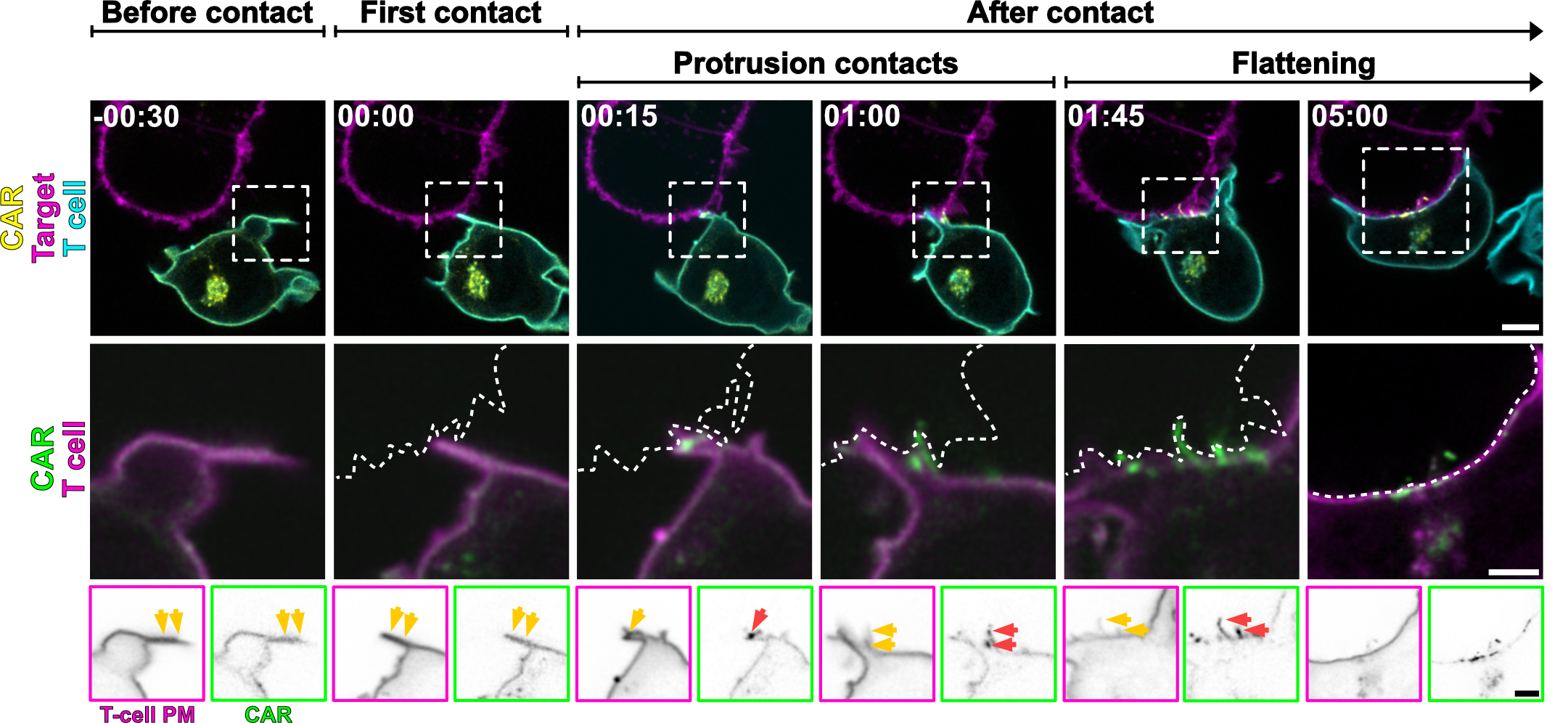
Overall, this work supports a model in which the contribution of actin-rich protrusions to early activation is not a consequence of a pre-enrichment of signalling proteins in their membrane, but a consequence of their enhanced ability to form contacts that efficiently exclude phosphatases and accumulate receptors.
Francesca Bottanelli, HFSP researcher at Freie Universität Berlin, Germany, explained that “this HFSP grant allowed us to launch an entirely new line of research in the laboratory. By applying our genome engineering and quantitative microscopy pipeline to immunology, we unexpectedly became ‘accidental immunologists’ and now we’re hooked!". This work is being carried out in collaborating laboratories at Yale University, USA, under the supervision of HFSP researcher Xiaolei Su, and at Nanyang Technological University in Singapore by Wenting Zhao. Ongoing in vitro reconstitution work using nanofabricated structures is expected to provide deeper mechanistic insights into the underlying signalling processes.