


































Seasonal timing is one of the most critical challenges faced by perennial plants. In temperate and boreal regions, trees must halt growth before winter to avoid frost damage, then restart growth in spring at just the right moment to maximize survival and productivity. A crucial aspect of seasonal adaptation in trees is bud dormancy and dormancy release, which underpins forest health, ecosystem functioning, and forest productivity. While it has long been known that prolonged exposure to cold is required to release dormancy, natural winters are rarely uniform. Instead, cold periods are frequently interrupted by warmer spells, raising a fundamental question: how do trees reliably interpret such noisy temperature signals to decide when winter has truly passed?
In their paper, the HFSP Research Grant awardees showed that dormant buds do not simply count accumulated cold hours. Instead, they actively process patterns of temperature fluctuation, using intermittent warm spells as meaningful signals to decide when to start counting cold. Experiments in hybrid aspen trees revealed that long warm spikes embedded within cold periods can block dormancy release—even when the total amount of cold exposure would otherwise be sufficient. This demonstrated that buds distinguish between sustained winter-like conditions and transient cold, allowing them to avoid prematurely resuming growth during early autumn or unstable winters. In essence, buds treat warm interruptions not as noise, but as information about seasonal progression.
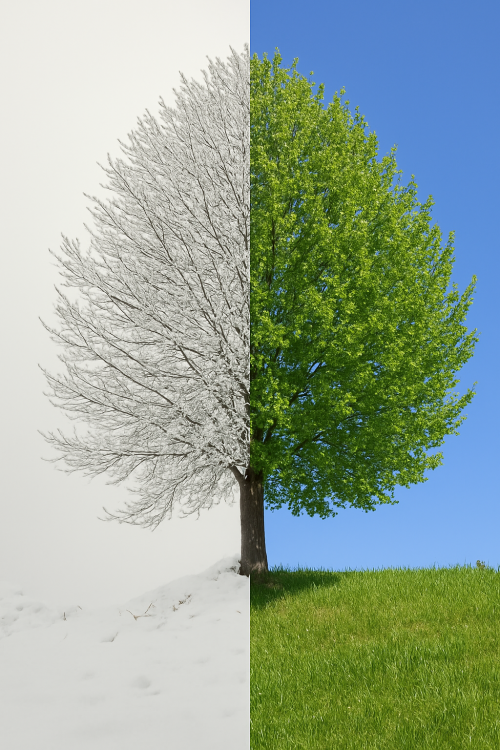
The HFSP-supported scientists identified dynamic regulation of plasmodesmata—microscopic channels that connect neighbouring plant cells—as the key mechanism underlying this temperature processing. Sustained cold (or cold with short warm spikes) promotes the reopening of these channels by reducing callose deposits that block cell-to-cell communication, enabling coordinated growth reactivation. Long warm spikes, however, suppress this reopening by preventing activation of the tree ortholog of Florigen, FT1 and the gibberellic acid pathway, both of which were shown here to directly promote plasmodesmatal opening. By linking environmental temperature patterns to tissue-level communication, the study revealed an unexpected role for plasmodesmata as integrators of long-term environmental signals.
Beyond explaining how trees achieve robust seasonal timing, the findings also shed light on variability in biological responses. The authors showed that fluctuating temperatures increase differences in the timing of bud break among genetically identical buds—a form of bet hedging that may protect a fraction of individuals in populations from unpredictable frosts. By uncovering how temperature variability is translated into both stability and diversity of developmental outcomes, this work provides a conceptual framework for understanding plant adaptation to increasingly erratic climates. These insights are especially relevant in the context of climate change, where warmer winters and altered temperature fluctuations are already disrupting dormancy release and threatening forest and fruit-tree productivity.